
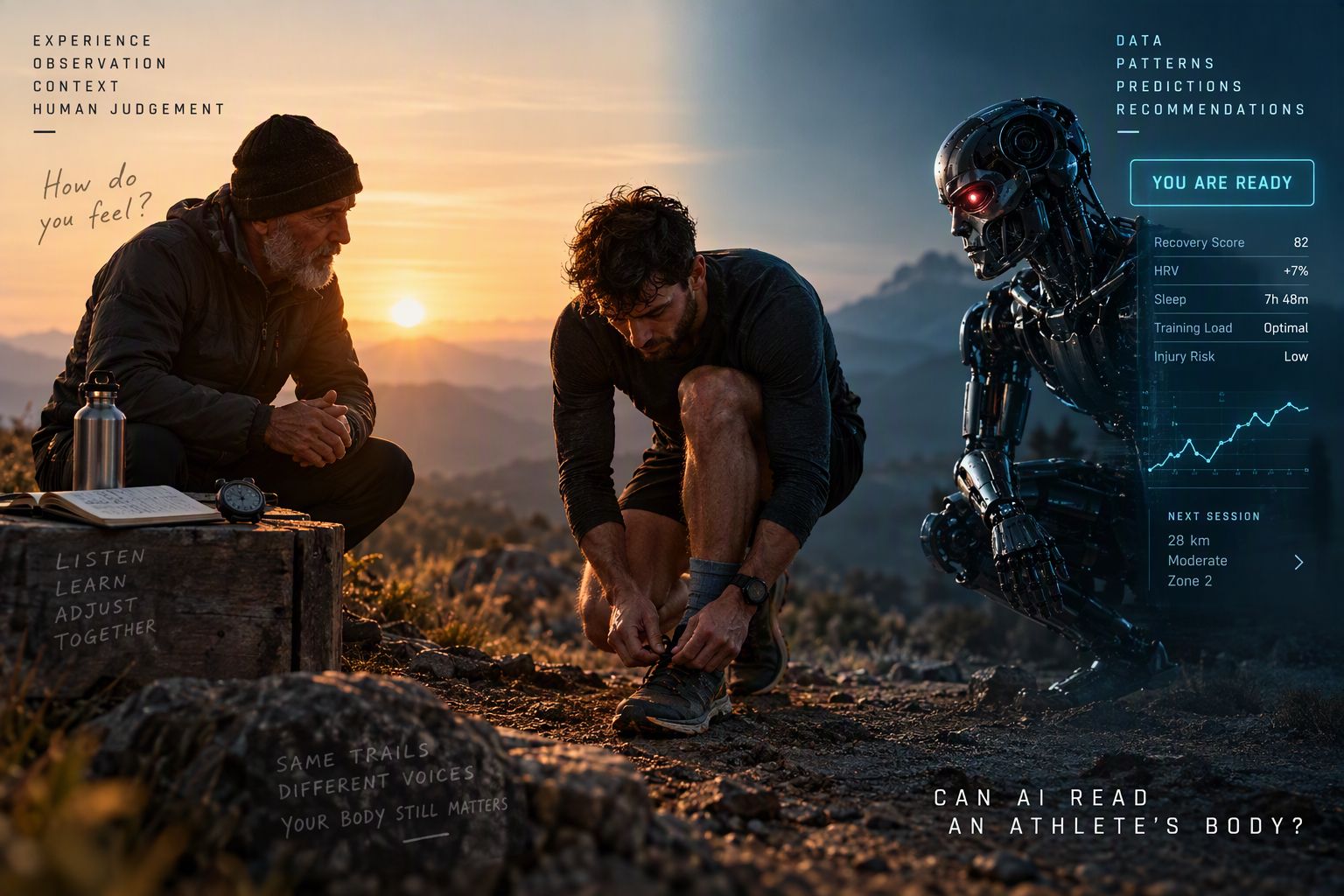
Can AI Read an Athlete's Body?
Okay, it is true. An AI can process more training data than any athlete or coach. But what kind of body does it actually know? I am a personal trainer myself. At a time when gym influencers flood the web, I have to wonder whether any niche is left for us human experts. Let's explore what AI can really do and what current research says.
My training app says I am ready. My recovery score is good. I slept well enough. My resting heart rate is normal. The planned mileage fits my recent training load. Nothing in the data suggests that today should be a problem. But when I stand up, something feels wrong.
Sport practice has changed quickly with the arrival of AI in wearables. Alkasasbeh et al.[1] synthesised 57 studies in a narrative review. They asked whether the promises hold up: better performance, lower injury risk, sounder return-to-play decisions. Their answer is cautious. The evidence supports AI as a decision-support tool with a human in the loop, not as an autonomous authority. Ethical questions about data privacy and transparency come on top.
So, the data says go and my body says wait. Or the other way round. Which one do I trust?
There is nothing wrong with relying on data, as coach or athlete. Too much of it can still do harm if we never read it against experience of the trainee or knowledge of our own body. The review stresses that model outputs are probabilistic guidance, not verdicts. It also warns that false positives and false negatives carry real consequences. Then there is transparency. Black-box systems make it harder for practitioners to trust them, and harder to question them. If you rely only on what your watch tells you, you rely on logic you cannot inspect.
The reverse can happen too. I feel ready because I want to run. The race is close. The weather is good. Skipping the session would disrupt the plan. My body feels fine because I have become good at normalising fatigue. Meanwhile, the system sees a pattern I have missed. Recovery is declining. Strain is rising. My training load has increased. Perhaps I failed to notice it. Perhaps I refused to notice it.
This is often framed as a contest between human intuition and technological calculation. But neither the athlete nor the technology meets the body neutrally. Both interpret it. Both work with incomplete information. Both can be perceptive. Both can be wrong. The more useful question may not be whether AI can know the body better than an athlete. It may be what kind of body each one can know.
The athlete as an unreliable witness
Endurance athletes build real knowledge of their bodies. Thousands of hours of training teach us how different kinds of fatigue feel. We learn to tell muscular soreness from depleted energy. We learn when heavy legs are harmless and when they might signal a problem.
Experienced athletes sometimes know that a sensation needs attention before they can explain why. This knowledge is built through repetition. A change in stride may show up before conscious thought. An unfamiliar tightness may feel wrong before we can put it into words.
But embodied knowledge is not innocent. The same sporting culture that teaches us to read discomfort also teaches us to ignore it. Pain becomes proof of commitment. Continuing becomes proof of character. Stopping feels like weakness. I wrote about this in The Disciplined Body. In Hall et al.'s work, ultra-runners trusted the runner-body over the doctor's advice. Their embodied knowledge was real. It also made them resistant to outside correction.
Endurance sport requires some tolerance of discomfort. No marathon or ultramarathon block would survive if every unpleasant sensation made us stop. We have to learn that discomfort does not always mean danger. That creates a problem. The athlete who becomes good at tolerating distress may also become good at explaining it away.
A familiar ache becomes "just part of training." Exhaustion becomes dedication. Poor sleep becomes temporary. A change in movement is dismissed because the race is close. The body keeps communicating, but we have learned to translate many warnings into encouragement. Embodied knowledge is real. It is not infallible.
The promise of the computational body
This is where AI-assisted coaching becomes attractive. A digital system can combine mileage, pace, power, heart rate, sleep, weather, previous performance, soreness and recovery estimates. I may remember how yesterday's run felt. I may still miss a pattern developing across several weeks. A coach may notice that I look tired. The coach may not have my sleep data, my heart-rate trends or my full training history.
An algorithm can compare the current pattern with a much larger record. Its advantage is not understanding in the human sense. Its advantage is consistency and scale. It does not become impatient when progress is slow. It does not care that the race entry was expensive. It does not share my need to complete the planned session. An algorithm might recognise a worrying pattern precisely because it does not want to run.
The review found that these systems can support individual training plans, workload regulation, recovery monitoring and injury-risk estimation. Rothschild et al.[2] are one example. They used machine learning to predict daily recovery during long-term endurance training, and the review reports that such models supported individualised recovery estimates. These tools bring together physiological, biomechanical and behavioural information that one person would struggle to process. Yet the authors do not present AI as an independent authority. Its usefulness depends on data quality, model validity, context and professional judgement. Hence the human-in-the-loop recommendation. AI should support a decision. It should not make the decision alone.
There is also a catch, and it goes straight to the question in the title. The review notes that much of the research rests on elite and team-sport samples. Many datasets are small or homogeneous, and external validation is limited. Recreational participants and less-studied disciplines are underrepresented. So, the body an algorithm knows best may not be mine. It is the body of the population it learned from.
That distinction matters. AI may identify a pattern that an athlete or coach has overlooked. This does not mean it understands what the pattern means for this athlete, on this day, in this situation.
What never becomes data
An AI can process a description of pain. It cannot feel pain. It can classify fatigue, but it has never been fatigued. It can recognise language associated with fear of reinjury. It has never hesitated before a movement because that movement once made its own body fail. Does that matter?
Maybe not always. A thermometer does not need to experience a fever to measure one. A system does not need to experience an injury to recognise a pattern associated with higher risk. But training decisions rarely involve clean measurements. I might report tightness rather than pain. Something may feel unusual without feeling alarming. A leg may be physically capable while remaining psychologically difficult to trust. I may change how I move without noticing. I may describe the same sensation differently depending on who is asking. I may not understand it well enough to describe it at all.
The review makes a similar point about the mind. Sleep, heart rate variability and recovery scores are indirect proxies for psychological strain. They should be read alongside self-report and professional judgement. I described this narrowing in When Garmin Starts Telling the Story. The moving body gets reduced to parameters, and a run becomes the numbers it leaves behind.
Athletes also have reasons to withhold information. We may downplay pain because we fear being told to stop. We may overstate our readiness because we want approval. We may assume a vague sensation is not worth mentioning. If you do not share everything with your coach, how should they know what to do? Even an AI does not meet the whole body. It meets the body that becomes legible through measurements, categories and reports. That body is never final or complete.
The athlete lives the body before it becomes data. A sensor records a change in movement. The athlete experiences the uncertainty. A system records poor sleep. The athlete lives the anxiety that caused it. An application records that a session was completed. It does not capture the negotiation required to complete it. The data can be accurate and still incomplete.
The human coach is no simple answer
It is tempting to present the human coach as the solution. But coaches also work with incomplete information. They can misread athletes. They can overlook distress. They may pass on harmful ideas about toughness. A coach can know an athlete well and still see only a small part of their daily life. Quality varies too. The title does not guarantee expertise, empathy or sound judgement.
Still, a good coach notices things that are hard to quantify. An answer may sound rehearsed. Language may change. An athlete may hesitate before describing a session, or insist too quickly that everything is fine. Movement may look guarded even when the numbers appear normal. These observations come from relationship and context, not from physiology alone.
A coach does not only interpret the athlete's data. A coach interprets the athlete interpreting their own body. A good coach may know that this runner tends to understate pain. They may know that an upcoming race has become tied to the athlete's identity. They may recognise that a recent injury has reduced confidence. AI may eventually model some of these patterns. It may detect a shift in language or compare today's report with previous answers. But modelling the signs of a relationship is not the same as taking part in one.
Four ways of knowing the body
At least four forms of knowledge can shape a training decision:
- The lived body. Something does not feel right. This knowledge arrives before measurement or explanation. It can also be shaped by anxiety, desire and previous injury.
- The experienced athlete. I have felt this before. I know what it means. Experience reveals fine distinctions. It can also create overconfidence.
- The human coach. I know how you usually respond. The coach brings observation, comparison and context. The judgement remains subjective.
- The algorithm. Your data resemble a pattern associated with fatigue or injury risk. The system brings consistency and computational reach. It still depends on its data, its training population and the assumptions built into it.
None of these four has automatic authority. The challenge is not to find the most accurate voice. It is to understand how athletes decide which voice deserves to be believed.
The body before the data
AI could become a valuable part of training and injury prevention. It could recognise changes that athletes ignore. It could challenge the belief that more training is always better. It could encourage rest when ambition has distorted judgement. It could also miss the sensation that never becomes data. A sensor can log a fast split. It cannot log the moment a run simply feels good, what Zeiler calls eu-appearance.
The body may know something before the athlete can describe it. The algorithm may recognise something before the athlete is willing to admit it. Both possibilities matter. AI does not need to feel pain to recognise a pattern associated with injury. But recognising a pattern is not the same as understanding what pain means to the person experiencing it.
The most useful system may not be the one that claims to know the athlete's body. It may be the one that helps the athlete ask better questions about it. I think the only reasonable thing we can do is to try different approaches and see what works for us or our trainees. Lay off the wearable for a while, as I explored in “If It Isn't on Strava, Did It Happen?”. Use the data more heavily on another occasion. And be wary of any voice that claims to know your body without ever having met it.
That includes the gym influencer. I am not convinced they serve most amateur athletes well. A video reaches thousands of bodies at once, so it cannot be built for yours. It has no access to your sleep, your history, your injuries or your sense that something is off. Even the most sophisticated systems in this review need context and professional judgement to be useful. A reel needs none, and it tends to reward confidence over caution. If the algorithm should be one voice among several, so should anyone who is selling a routine. Listen, compare, and check it against the voices that actually know you: your body, your experience and a coach who has watched you train.
Next time: what happens when the system stops interpreting and starts giving orders.
Written by Ingo@Lozania-Lifestyle.de
References
[1] Alkasasbeh, W. J., Amawi, A. T., Grivas, G. V., Orhan, B. E., & Alawamleh, T. (2026). Artificial intelligence and wearables in sport: performance, injury risk, and wellbeing. Frontiers in Artificial Intelligence, 9, Article 1838507. https://doi.org/10.3389/frai.2026.1838507
[2] Rothschild, J. A., Stewart, T., Kilding, A. E., & Plews, D. J. (2024). Predicting daily recovery during long-term endurance training using machine learning analysis. European Journal of Applied Physiology, 124, 3279–3290. https://doi.org/10.1007/s00421-024-05530-2