

When Garmin Starts Telling the Story
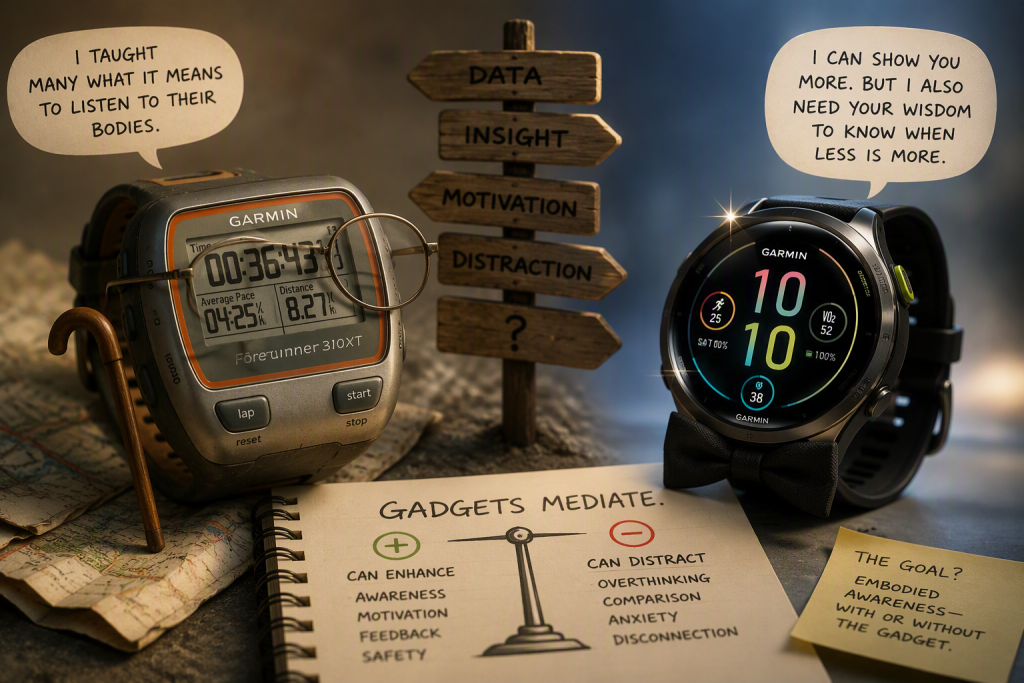
I do not even own a Garmin, not anymore, anyway. When I started running, I must have been around 14 years old. My dad drove me to run that loop I couldn't leave (read more >>here), chain-smoked a pack (not anymore!), and stopped my time on an old-school stopwatch. I neither recorded any of this nor published it on social media — not that that would have been an option back then. Fast forward to 2012: I did buy a Garmin Forerunner 310XT for an absurd amount of money. I decided to train for an Ironman, which I never ended up finishing. I used the watch until I retired it in 2021, when the wristband broke, and I exchanged it for a cheapish Honor GPS gadget.
Running gadgets are everywhere now. Whether the data they collect genuinely sharpens our sense of the body, or quietly reshapes it into something else, is a harder question — and one that a recent paper by Aggerholm et al.[1] take seriously. Working from Drew Leder's[2] 1990 theory of embodiment, the authors propose a new concept: the digi-appearing body. Their argument is that digital self-tracking devices don't just record our bodies, they change the way our bodies show up in our awareness at all, and they do so along three distinct lines: reduction, externalisation, and optimisation.
Reduction: the body as data point
Leder's original framework describes a body that is mostly absent from our conscious awareness — quietly getting on with things — until something disrupts it. Pain, discomfort, a stumble: these are what make the body "appear" to us, what he calls dys-appearance. A pair of cushioned trail shoes works precisely because it keeps the body from appearing this way; it absorbs the discomfort before it reaches awareness.
Tracking devices complicate this picture: They don't wait for pain to bring the body into focus. They do it constantly, through numbers. Heart rate, pace, elevation gain, cadence: the moving body gets reduced to parameters, binary and legible, long before anything actually hurts. Aggerholm et al. call this a parametric mode of revealing. It's genuinely useful, it makes visible things we'd otherwise have no access to, like a kind of microscope for the recessive body. But it also risks narrowing our attention onto the numbers at the expense of everything else that a run actually is: the particular quality of a morning, the company, the terrain underfoot.
Externalisation: not extension
It would be tempting to think of a running watch the way we think of a blind person's cane — as something that quietly becomes part of how we sense the world, an extension of the body's awareness. Aggerholm and colleagues explicitly reject this framing. Extension, in the phenomenological sense, has to stay rooted in lived, pre-reflective sensation. It has to grow out of something felt. But the data on a Garmin or a Fitbit isn't felt. It sits in the app whether or not you ever look at it, disconnected from the joy of the climb or the ache in your legs. The authors call this externalisation: the body doesn't extend into the data; it gets doubled by it. The literature has various names for this doubled self: data double, digital twin, digital doppelgänger; but the shared idea is the same: a version of you, made of numbers, existing alongside the version of you that's actually moving.
That doubling isn't automatically alienating. Reviewing your splits after a long run can genuinely deepen your understanding of your own patterns: habits and pacing tendencies you'd never have noticed otherwise become visible and open to change. But the risk the authors flag is real too: if the felt run and the data-run drift too far apart, you can end up trusting the number on your wrist over the sensation in your legs.
Optimisation: the problem of never being finished
The third dimension is where the sharpest critique sits. Once the body has been reduced to numbers and externalised as data, it becomes something to optimise rather than something to simply live in. And optimisation, on a device, has no natural stopping point. Aggerholm et al. draw here on Hartmut Rosa's idea[3] of social acceleration, and Thomas Fuchs's[4] contrast between monolinear clock time: always pushing forward, always demanding more; and the cyclical rhythms that actually govern a body: fatigue and recovery, effort and rest, the turning of seasons. A tracking algorithm doesn't recognise cycles. It just recalibrates upward. Hit your target zone minutes this week, and the app raises the bar for next week, regardless of whether your legs, or your life, have room for more. The danger the authors name directly is getting "lost in perfection": training and movement becoming an end in themselves, detached from the broader question of what any of it is actually for.
As it happened, last week was a chance to run "offline" again. No technical error, just an event Sina and I signed up for that didn't allow any electronics — just a map and your orientation skills. No idea about distance, altitude or pace, just trying to finish the 1-, 2- and 3-hour loops on time. Spoiler: no one finished the second loop within the time limit, though we ran it anyway and started the third — for the sake of it, the fun, and our gratitude to the organizers. They say: "if it isn't on Strava, it didn't happen"; my legs would beg to differ. More on that soon from Sina — stay tuned!
Written by Ingo@Lozania-Lifestyle.de
---------
[1] Aggerholm, K., Ronkainen, N. & Schmidli, X. The digi-appearing body: bodily awareness when mediated by digital self-tracking technologies. Phenom Cogn Sci (2025). https://doi.org/10.1007/s11097-025-10102-6
[2] Leder, D. (1990). The Absent Body. The University of Chicago Press.
[3] Rosa, H., & Trejo-Mathys. (2013). Social Acceleration—A New Theory of Modernity (J. Trejo-Mathys, Trans.). Columbia University Press.
[4] Fuchs, T. (2021). In Defence of the Human Being: Foundational Questions of an Embodied Anthropology. Oxford University Press.