
Who Carries the Movement?
From parkrun to Thailand
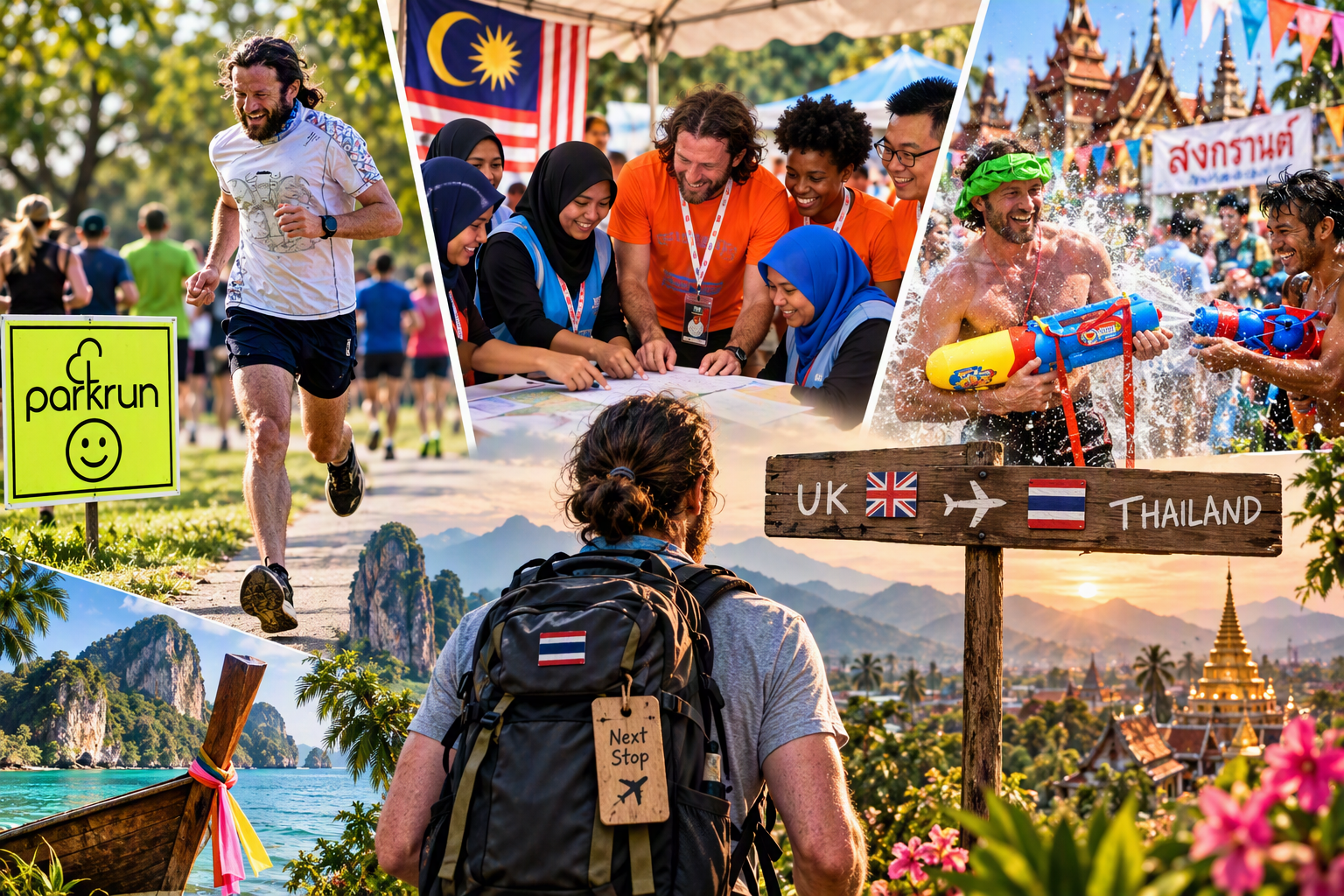
On 4 November I fly to Thailand, and no, not because ThAIland has an AI in it, after all that talk about technology. Before I do, I want to follow a question that keeps surfacing in my reading: who actually carries movement into a community, and who gets left out?
After all that talk about technology, I want to return to what sport can mean for communities. In a recent post I argued that parkrun may reinforce social norms rather than build bridges. That study used data from 2018, so I was glad to find a more recent account by Helen Quirk.[1] She interviewed ten UK parkrun Ambassadors, volunteers who promote parkrun to underrepresented communities. parkrun’s pledge is “Free, for everyone, forever”, yet participants tend to be white and of higher socioeconomic status. Open to all is not the same as reaching all, and Quirk argues that events like this need targeted outreach.
The Ambassadors’ work ranged from busting myths (you can walk, and speed does not matter) to approaching housing associations, local authorities and politicians, with mixed results, to helping set up new events in deprived areas. One Ambassador called the latter the most effective thing they had done, and others felt that engaging parents directly would work better than reaching children alone. These are perceptions, not evidence. Outreach has never been formally evaluated, there is no monitoring and learning system, and volunteers’ limited time keeps their work small and local. That is the catch of volunteer-led engagement: it is only as big as the spare hours of the people carrying it.
Thailand shows what volunteer engagement looks like at national scale. The village health volunteers (VHVs) have been part of the health system since the 1960s, the WHO has acclaimed the programme, and in 2010 there were more than 800,000 active volunteers.[2] ThaiHealth now counts over a million.[3] Kowitt and colleagues interviewed volunteers, community leaders, community members and health officials in three semi-urban communities in central Thailand, although interviews were mostly arranged through community leaders, which may colour the picture. Volunteers worked from existing, trusted relationships, and partnership with public health officials strengthened rather than weakened that trust. They described a “service mind”, an inherent wish to help, as more important than any skill.
Scale brought tensions. New activity logs, protocols and monthly meetings gave officials quality control, but volunteers felt they reduced the flexibility to tailor support to their community. A monthly allowance of 600 Baht (about 20 USD), introduced in 2010, drew mixed reactions: some volunteers welcomed the recognition and help with transport costs, others feared it would change the spirit of the programme, and some communities had to find new selection criteria as interest in the role grew. Physical activity is not the programme’s core mission, which centres on infectious and chronic disease, maternal health and elderly care, but local volunteers did organise a weekly walking group and dance activities for older people.
Mass running is booming in Thailand too. Jantori and Pongponrat report 700 mass running events in 2017 and 1,305 in 2018, and around 16 million leisure runners, roughly a tenth of whom regularly enter such events.[4] Their 15 interviews around marathons in Chonburi, Buriram and Chom Bueng found benefits that go well beyond tourism: community pride, better public spaces, shared knowledge and a new sports culture. One organiser said football speaks mostly to young men, whereas the marathon helped establish that sport is for everyone. In Chom Bueng, a man started running at 79 and finished his first marathon at 85. But the events are run by professional organisers with little community involvement, most interviewees were close to the organisation, and the study does not ask who is missing from the start line.
Side by side, each model has what another lacks. parkrun has an inclusion mission but not the capacity to scale it. The VHVs have reach, trust and state backing, but movement is a side activity. Thai mass running has momentum and pride, but little community ownership. My mantra of movement, nature and purpose asks for all three together. That takes people with a “service mind”, to borrow the Thai term, who care enough to reach out and help others find meaning in movement for health, and perhaps beyond it.
In a few weeks I will be on the ground in Thailand, looking for where these threads meet.
Written by Ingo@Loyania-Lifestyle.de
_____________
[1]Quirk, H. (2024). Engaging underrepresented groups in community physical activity initiatives: A qualitative study of parkrun in the UK. BMC Public Health, 24, Article 804. https://doi.org/10.1186/s12889-024-18314-2
[2]Kowitt, S. D., Emmerling, D., Fisher, E. B., & Tanasugarn, C. (2015). Community health workers as agents of health promotion: Analyzing Thailand’s village health volunteer program. Journal of Community Health, 40(4), 780–788. https://doi.org/10.1007/s10900-015-9999-y
[3]Thai Health Promotion Foundation. (2022, August 16). ThaiHealth supports enhancement projects among Village Health Volunteers. https://en.thaihealth.or.th/?p=152982
[4]Jantori, P., & Pongponrat, K. (2022). The intangible impacts of mass running events on communities: Evidence from Thailand. Human Behavior, Development and Society, 23(1), 42–49. https://so01.tci-thaijo.org/index.php/hbds/article/download/253295/170205/945799