
On the Map, On the Move
For the first time on Lozania Lifestyle, this one is written together, in real time, rather than handed from one of us to the other. Today's post is about yoga, and about what happens when you put a practice built on stillness up against a life built on trails and departure gates. So, starting with the words of our favorite Yoga teacher, Nina: “Wir beginnen im Fersensitz”.
Ingo: What does yoga have to do with trail running, and why is this filed under Stories? First, because for me it started in a place where running was rarely feasible. Literally being down on my knees.
I was seconded to Nepal, to the rather polluted capital, Kathmandu. My lungs barely managed 5ks in the early morning hours around 4am, before the horrific traffic and exhaust fumes made it impossible to move. Some weekends we made it out into the mountains, which was, besides hazardous on a scooter, also quite a commitment. Budget roughly four to six hours just to leave the city and get back into it. So long runs were more of a luxury. Nevertheless, Nepal is the place where I started yoga, eased into the practice during a three-day course my hosting NGO offered its volunteers. What better place to start than with the Himalayas in the background?
That was 2017. I started it as an escape from the hassle, but it turned into something closer to an intervention, for both my mental and physiological well-being.
Sina: Sardegna is where I started. Lithuania is where I'm writing this line. Which is, I think, the shape of this whole post: two very different starting points, one shared practice, and now a shared page.
I got pulled in properly once I saw what it was doing for Ingo, and since then we've been adding yoga to our weekly training schedule. We sometimes struggle to manage two sessions a week at home, but we're rather consistent whenever we travel, which is exactly what's happening as I type this.
Ingo: Before we get to the travel side, let's see what the research says. There's a decent starting point.
Grilli Cadieux, Gemme and Dupuis[1] conducted a systematic review of the evidence on yoga's benefits for athletes, mental and physical. Long story short: yoga helps. It offers a holistic approach to athletes' health, flexibility being one part of it, breathing technique and the meditation that's often folded into a practice being another.
Sina: As the resident psychologist here, I have to flag the caveat before you get too excited: the review pulled together just six trials, all rated poor quality on a standard checklist, with 152 participants between them and 86% of them men. Encouraging direction, not proof.
Ingo: Fair. Though the "why" is interesting too. Sport psychology has traditionally leaned on performance metrics to judge what works. It's only recently that the field started paying closer attention to the mental side, looking for methods that bridge body and mind. Body psychology, as a field, is fundamentally concerned with exactly that connection, which is, incidentally, the degree I'm halfway through.
Sina: And that's where my old training kicks in. The toolkit has moved through several phases: cognitive behavioural therapy first, then Psychological Skills Training, and more recently mindfulness and acceptance-based interventions. Critics of PST point to a real paradox: trying to control negative thoughts and emotions can end up amplifying them. Mindfulness works differently. It asks you to accept and tolerate whatever you're feeling, positive or negative, without judgement, which some of the literature Grilli Cadieux et al. draw on suggests works better than trying to suppress emotion outright.
Ingo: Which loops back to yoga, since mindfulness is rarely practised in isolation. It's often folded into the practice itself. Styles vary hugely, from powerful, dynamic flows to more spiritual practices, but yoga as a whole offers a toolset for flexibility, body control, breathing and mental well-being. The review notes that athletes, used to intense and frequent training, tend to respond well to active interventions like yoga, more so than to purely contemplative practices such as meditation alone.
Sina: Which is also the honest caveat. The six trials varied wildly: different yoga styles, interventions running anywhere from four to eight weeks, sessions between 30 minutes and nearly three hours. Anxiety showed the strongest, most consistent effect, an effect size of 1.18, echoing what's already well established outside sport. Performance was a different story. Only half the six studies measured it at all, and while the average effect looked moderate at 0.52, the confidence interval ran from −1.08 to 2.11, wide enough to include zero. Too many variables to draw a clean line from mat to podium.
Ingo: So: good for the mind, probably, unproven for the stopwatch. Which is fine by me, since the mind is the part I actually went looking for.
Sina: Which brings me back to where I actually wanted to start. Sardegna is where I started yoga. Lithuania is where I write this.
When travelling, we often focus on where we are going. We book the flight, the accommodation, plan the places we want to visit, choose restaurants that might suit us, and imagine what the destination will be like. We read articles and reviews, look at photographs and maps, and think about what comes next. Even in the most beautiful locations, part of the mind can be somewhere else, already planning the next step. Sometimes the anticipation of a place becomes more vivid than the place itself.
One of the simplest ideas in yoga is simultaneously one of the hardest to practise: pay attention to what is actually happening. Not what you expect to happen. Not what happened yesterday, or what's on the mental checklist for tomorrow. Right now.
We may arrive on the mat expecting to feel calm and relaxed. Instead, our hips are tense and we lose balance. We were focused yesterday, but today the mind is distracted, and shavasana becomes a challenge. Yoga asks us to just notice it, not to match the expectation, but to meet reality.
Ingo: That "meeting reality" part hit differently in Kathmandu than it does here, for what it's worth. In Nepal, staying in the moment meant staying with the noise, the traffic, the exhaust in every breath. Running gave no reprieve either. If anything it made things worse: you're out there specifically to clear your head, and the head won't clear, because the body is too busy filtering everything the city is throwing at it. A very different "now" to sit with than on a beach in Sardegna.
Sina: Which is maybe the real thread here. Another connection between yoga and travel is the chance at a different relationship with time. Everyday life has us hurrying between obligations, optimising routes, doing several things simultaneously, filling every empty, otherwise "useless" space. Travel interrupts that rhythm. You sit on a bench for twenty minutes because there's nowhere else you need to be. You take the long way back to the hotel. You watch someone sweep the pavement. You notice the changing light on a building you've already passed three times.
Nothing has been "achieved." And yet something has happened. Yoga contains that same resistance to constant productivity. A posture doesn't have to produce a measurable result. Sometimes the point is simply to remain with an experience long enough to notice its subtleties. Perhaps that's one of the quiet gifts of travel: permission to stop being efficient.
Ingo: Which is exactly the paradox we keep bumping into, actually. While travelling, we're about as unhurried as we ever get. Go with the flow, let the day shape itself, no fixed itinerary. But put us on a run in an unfamiliar city and something flips. Suddenly we're the ones getting tense, weaving through people who are doing exactly what we're praising two paragraphs up: standing still, taking it all in, not rushing anywhere.
Sina: It's true. Navigating a route through a crowd that has nowhere to be and no reason to move can be surprisingly demanding, occasionally outright annoying, for the one person there who does have somewhere to be, however self-imposed that somewhere is. Same trip, same city, two completely different relationships to time and space, depending on whether we're moving at a walk or a run.
Ingo: Which is probably its own post. Lithuania gave us plenty of that particular contrast: unhurried on the mat and between sights, considerably less unhurried trying to get a run in around Vilnius, in Nida, Palanga, or in Kaunas. More on that soon, a real story about trails, in Trail Stories.
Sina: For now, if you want to try any of this yourself: we mostly practise via YogaEasy, flexible enough to fit around whatever the day looks like.
Ingo: And if you're a trail runner wondering whether any of this is worth the mat space: in our experience, yes, for reasons that go beyond what the research above could measure. Single-leg balance work translates almost directly onto technical terrain. Hip and ankle mobility opens up stride length and uphill mechanics that running alone rarely trains. Breathwork gives you something to fall back on when a climb gets ugly. And the body awareness yoga builds is the same body awareness that lets you catch a niggle before it becomes an injury, rather than after.
Sina: Which brings it right back to eu-appearance, doesn't it (>>here). The body standing forth as good, easy, well, rather than needing pain to notice it's there at all.
Ingo: Exactly that.
Route notes
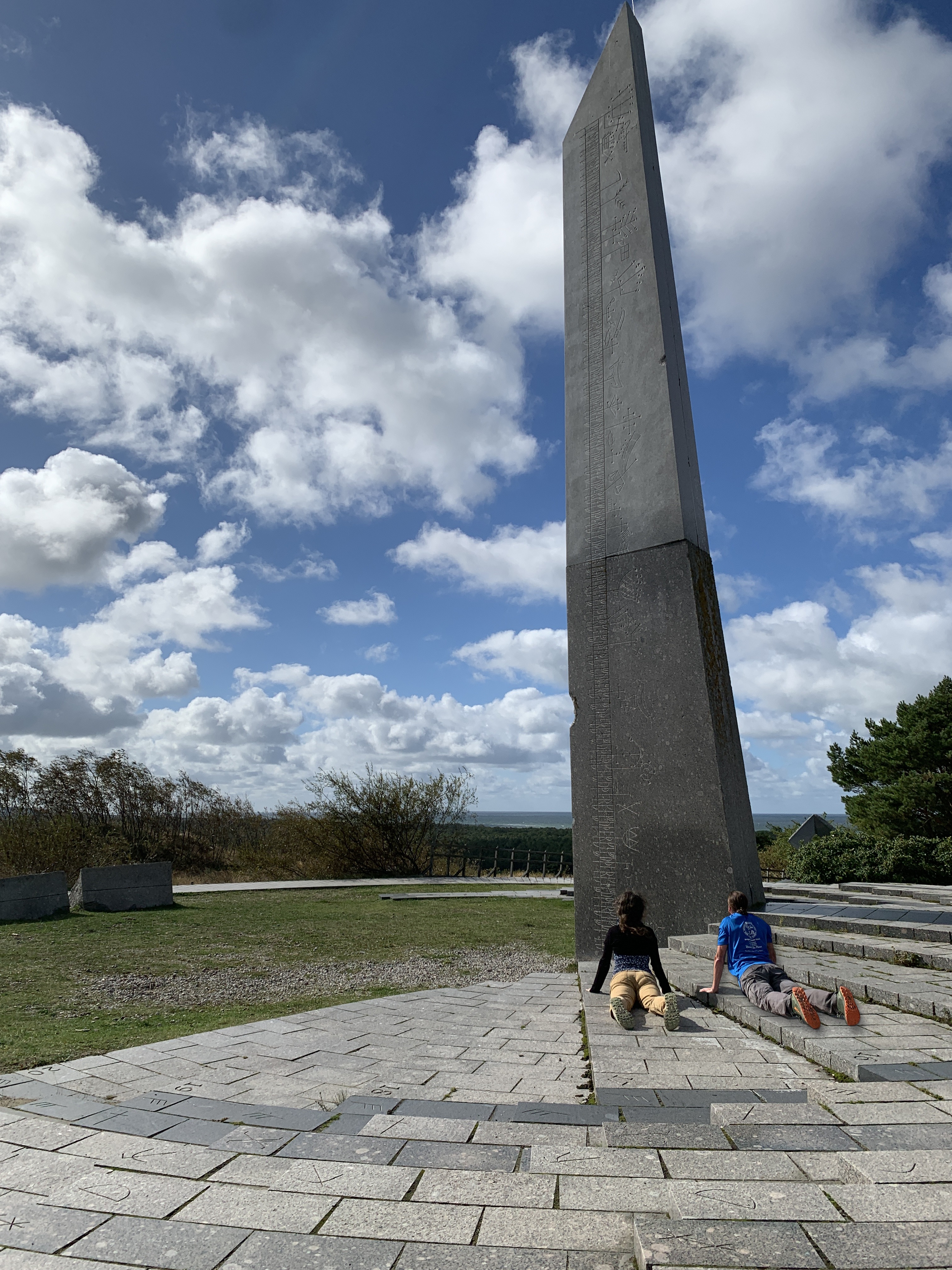
Where: Genuinely anywhere. The beach (headstands are a bit of a mess), a hotel room (on the matress, couch or floor is fine too), and, most recently on the platform of a sundial with no particular plan for balance.
Platform: https://studio.yogaeasy.de/
Try this: Nina Heidmann, our favourite teacher there, teaching Vinyasa, our favourite style.
Also worth knowing: You don't need to be capable of every pose. Yoga is allowed to be fun too.
…
Co-edited by Sina@Lozania-Lifestyle.de and Ingo@Lozania-Lifestyle.de
[1] Grilli Cadieux, E., Gemme, C., & Dupuis, G. (2021). Effects of yoga interventions on psychological health and performance of competitive athletes: A systematic review. Journal of Science in Sport and Exercise, 3(2), 158–166. https://doi.org/10.1007/s42978-020-00104-y