
Keep the Ocean on Your Right … and KEEP Going.
Today’s Trail Voices brings you: Dianie.
The route came with one instruction.
“Make sure the ocean is on your right, keep going for about 30 kilometres, and your hotel will be there.”
That covered a three-day run along South Africa’s Wild Coast, ran with a friend from school. Rivers to cross, long beaches, very rural communities where people still live in traditional mud huts, and dolphins offshore. Baggage went ahead by vehicle each day, so all that was left to do was run and look around.
“It was absolutely gorgeous and genuinely wild.”
There were also plenty of blisters. Because they had been crossing rivers with open feet, the medical staff treated them every evening to keep the infection risk down. The antiseptic, she says, burned like hell — a detail that sits just as comfortably in the memory as the dolphins do.
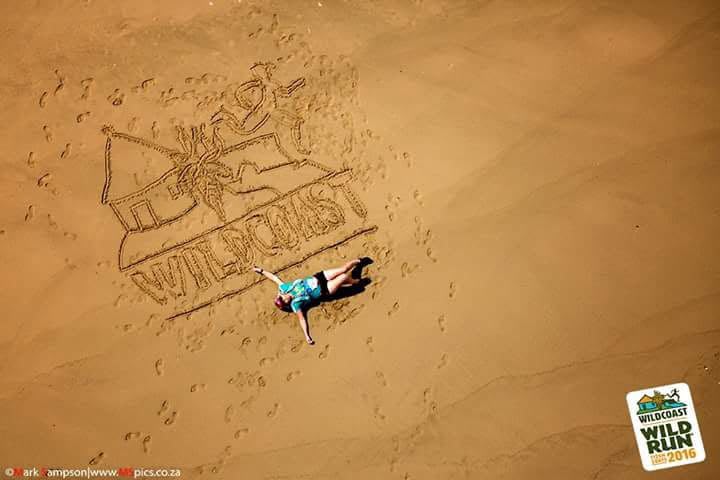
The photograph above was taken by someone she met on that same run, an event photographer who now covers everything from trail races to golf tournaments around the world. The sand art were already there, the angle wings she attached when she had arrived; she simply lay down underneath the illustration as she liked how it looked; and the moment. The organisers used the shot in their own marketing for a couple of years afterwards.
From bicycles to blisters
Running was not the starting point.
“At school, I went jogging with my dad once or twice. Then I went to university, became very inactive, and did not do sport for many years.”
It came back through bicycles, once her children were young: three or four years of road cycling and mountain biking, the mountain biking especially. She is cheerfully upfront about how that went — dangerous on a bike, dangerous on her feet too, but a bike lets you fall harder and faster. There were one or two head-first swan dives.
After her third child, a bike stopped making sense. It needs maintenance and it needs time, and what a one-hour run gives you can take two or three hours on two wheels. With a young family, those hours were hard to find. So she went into a shop, bought a pair of ASICS because she remembered the brand from school, and started the way most people start: 5K, then a half-marathon.
Trail running arrived when a friend asked her along to a multi-stage event, and her first reaction was the only sane one:
“Why would anyone want to run 30 kilometres once? Why would you want to do it three days in a row?”
She trained for it anyway.
Today, and again tomorrow
That first multi-stage event was in the Southern Cape: one day of forest, one day of mountains, one day of beach.
“It was amazing to discover that you can run 30K today, get up and do it again tomorrow, and then do it again the next day.”
Dianie ran it with a friend who had not trained and assumed she would be fine anyway, which meant plenty of waiting around and an easy pace. She loved the evenings and the prize-givings, and especially the community. South Africa has a great many multi-stage events, and she has since done a lot of them.
Harder, and somehow more relaxed
Road running, our Trail Voice said, makes you faster and more goal-oriented. Trail running does something else.
“Trail running makes you stronger and is a little more relaxed, even though it is harder. People are less serious about it.”
She stops constantly to take photographs, not as a break from the run but as part of it.
“You get to see nature in a way that you cannot experience through any other form of running.”
And, whenever the situation allows, a beer from a stranger along the way.
“I have accepted beers from people along the route. That is a particular talent of mine.”
Enjoying the misery
Not every run feels relaxed. On one particularly “brutal” (very recent) route, at the 25-kilometre mark, Dianie decided she would rather suffer alone than cheerfully:
“Please leave me now. I want to slow down and walk. I do not want to see how fresh and cheerful you are, smiling and laughing. I just want to enjoy my misery for 10K.”
She reduced the whole lesson to four words:
“The trails humble you.”
Then she said the run was good. Really good.
The ten days she could not run
Injuries, on the whole, have left her alone. There was a broken arm that she ran with anyway; six weeks into an eight-week cast, she turned up at an event and the organiser asked what on earth she was doing there. Luckily it was a removable cast, off after the run, into the laundry, back again like new.
The real test came from something else entirely: COVID, in South Africa, over December, with her mother and father sick as well.
“There was a period of 10 or 12 days when I could not run. It was especially difficult because December is summer.”
Summer, on a coast she calls one of the most wonderful places to run, two hours outside Cape Town where her parents live. She was flat on her back. Her medium schnauzer, Amy, usually good for a 10-to-20-kilometre run, could not go out either. Ten days does not sound like much. It is the one she remembers as the hardest.
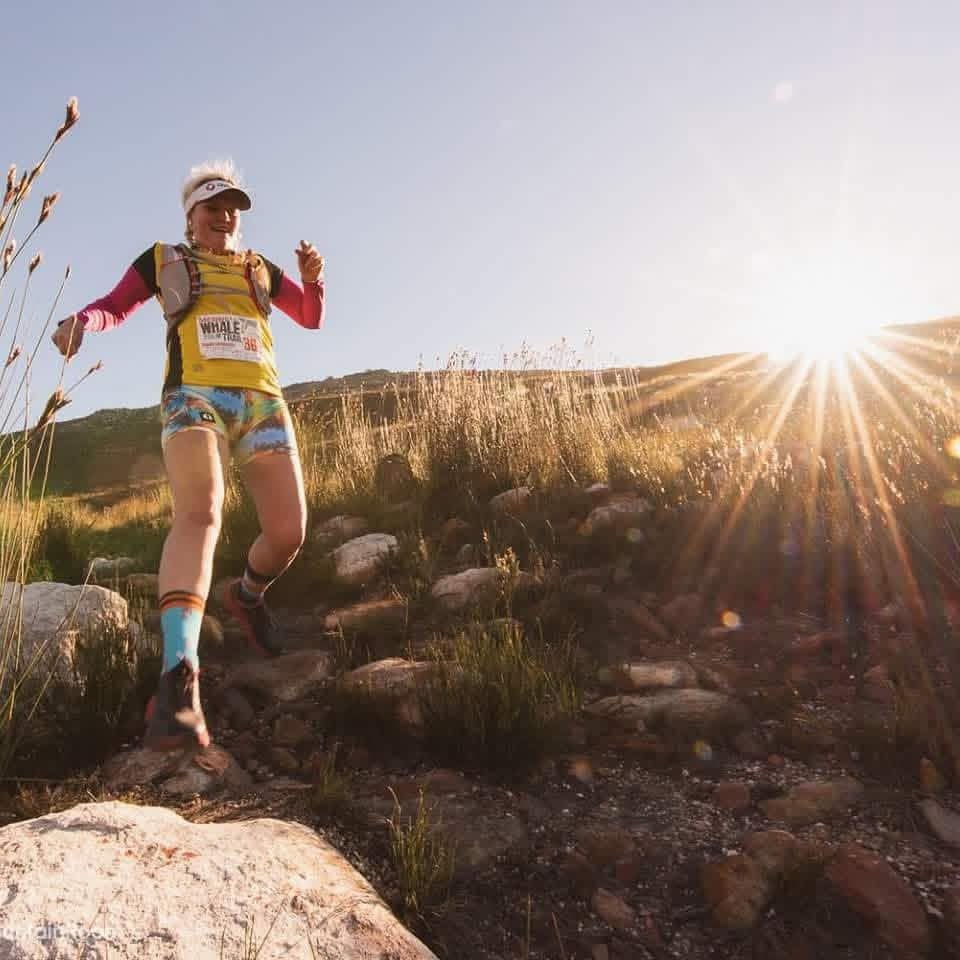
The second photograph is from her first ultra event, and by her own account it turned up in this pile more or less by coincidence.
“It is roughly 25K inland and then 25K along the coast, with southern right whales visible along the way. That was a very interesting event.”
Somewhere worth going
Her plans read like a travel itinerary that happens to involve running.
Next is the Médoc Marathon near Bordeaux: about 22 wine estates, wine tasting, oysters, ice cream, and other food along the route, all in fancy dress. This year’s theme is the 1980s, and she already has a costume. It will be her fourth time.
After that, Lake Garda again, this time properly trained and hoping for an easier day than the five hours it took her the first time round. And THE 76-kilometre Rennsteig Lauf, with no time goal attached: just a strong finish, no injury, and none of the “personality failure” from her last brutal weekend out.
Everyone should be doing it
Asked what she would like people to remember, Dianie did not hesitate.
“Everyone should be doing it. You get in touch with nature and experience it in your own way.”
She added, almost as an afterthought, that you get in touch with yourself too, and thought of her own children, whose lives make getting outside a far more deliberate effort than it used to be.
And if a route ever needs no more explanation than this, the Wild Coast version still wins:
Keep the ocean on your right, and keep going.
P.S. Somewhere near the end of the interview, Dianie was introduced to the Hash House Harriers, self-described as “a drinking club with a running problem.” Her verdict: “It sounds right up my alley.”
Written by Ingo@Lozania-Lifestyle.de