
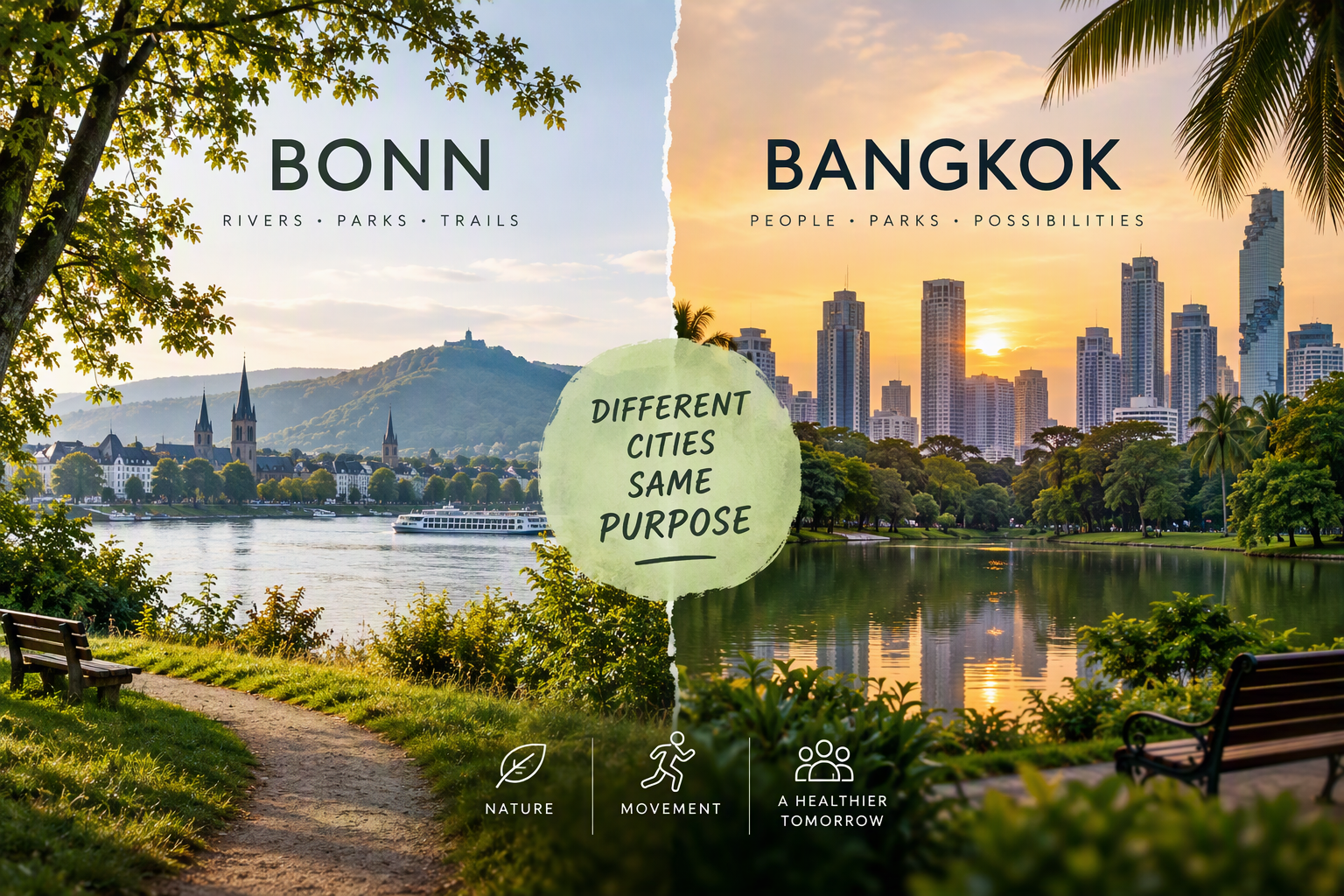
Bonn, Bangkok, and the Search for Meaningful Green Spaces
Part of my preparation for Thailand is understanding how cities support movement, health, and connection with nature. This article summarises two recent studies on Bangkok’s parks and reflects on how their findings compare with experiences from Bonn, Germany.
As I prepare for my trip to Thailand, I find myself reading research papers about Bangkok’s parks. It may not be the most obvious form of travel preparation, but for someone interested in movement, well-being, and our relationship with nature, it feels like a good place to start.
The comparison that immediately came to mind was Bonn, as the former capital of West Germany, Bonn enjoys an abundance of green space. The Rhine, the Rheinaue, the Kottenforst, and the nearby Siebengebirge make access to nature feel almost effortless. Bangkok, Thailand’s capital and one of Southeast Asia’s largest cities, faces a very different challenge. Millions of people share a dense tropical urban environment where space is limited and every park matters.
The numbers underline the gap. Almost half of Bonn’s 141 square kilometres is vegetation or water, and its woodland alone works out at roughly 137 square metres per resident.[1] Bangkok is estimated at 7.6 square metres of green space per person. That is below the 9 often cited as the WHO minimum, and perhaps nearer 3 if only usable public green space is counted.[2]
At first glance, the comparison seems unfair. Yet both cities are trying to answer the same question: How do we create environments that encourage people to move, recover, and connect with nature?
Arifwidodo[3] et al. surveyed 585 adults across Bangkok’s 50 districts. People who had visited a park in the previous week had almost four times the odds of meeting the WHO guideline of 150 minutes of moderate to vigorous activity per week. Park visitors also tended to report healthier lifestyles overall. Park use was not equal, though. Women had about half the odds of men of visiting, and the authors note that earlier research links this gap to safety concerns. Because the study is a snapshot, it cannot show whether parks make people active or whether active people simply go to parks.
Is Closer Always Better?
Bangkok’s recent 15-Minute Park initiative is based on a simple idea: everyone should have access to a park within a short walk from home. The city promised 500 small parks within 800 metres of every resident by 2026, and 196 were open by mid-2024. A survey of 615 residents tested what that proximity delivers.[4] The strongest positive associations with physical activity and well-being were found not for the smallest neighbourhood parks, but for larger community parks of 5 to 20 hectares. People living within 800 metres of one had more than twice the odds of meeting the activity guideline and of reporting good well-being. Pocket, neighbourhood, and 15-minute parks showed no significant link, although the estimates were imprecise, so this does not prove that small parks do nothing. Walkable neighbourhoods mattered even more, with over five times the odds of being active. Meanwhile, only about one in five respondents lived within 800 metres of a community park.
A Thought Before Departure
What I find most interesting is that these findings challenge a common assumption: We often measure green space in hectares, percentages, or walking distances. But perhaps the better question is much simpler: Do people actually want to be there? The studies do not measure that directly. They do point to what may shape it: size, safety, and walkability.
In just over a week, I will trade the Rhine for Bangkok’s streets, parks, and trails. One of my first experiences will likely be a run with the Bangkok Thursday Hash House Harriers. It will be interesting to see how the realities of movement, community, and urban nature compare with what the research suggests.
A successful park is not measured by how close it is.
A successful park is measured by whether it makes people want to step outside.
Written by Ingo@Lozania-Lifestyle.de
...
[1]Information und Technik Nordrhein-Westfalen. (n.d.). Kommunalprofil: Bonn, krfr. Stadt [Municipal profile, data as of 31 December 2024]. https://statistik.nrw/sites/default/files/municipalprofiles/l05314.pdf: Area: 141.06 km²; 4,417 ha of forest and woodland; 323,336 residents. The figure of roughly 137 m² of woodland per resident is my own calculation from these values.
[2]Thai PBS World. (2022, October 1). The greening of a city. https://www.thaipbsworld.com/environment/the-greening-of-a-city; Bangkok Post. (n.d.). Solving the city’s lack of green space. https://bangkokpost.com/thailand/general/2303294/solving-the-citys-lack-of-green-space
[3]Arifwidodo, S. D., Chandrasiri, O., Rasri, N., Sirawarong, W., Rattanawichit, P., & Sangyuan, N. (2022). Association between park visitation and physical activity among adults in Bangkok, Thailand. Sustainability, 14(19), Article 12938. https://doi.org/10.3390/su141912938
[4]Arifwidodo, S. D., Chandrasiri, O., & Rueangsom, P. (2025). Is proximity to parks associated with physical activity and well-being? Insights from 15-minute parks policy initiative in Bangkok, Thailand. Sustainability, 17(16), Article 7457. https://doi.org/10.3390/su17167457