
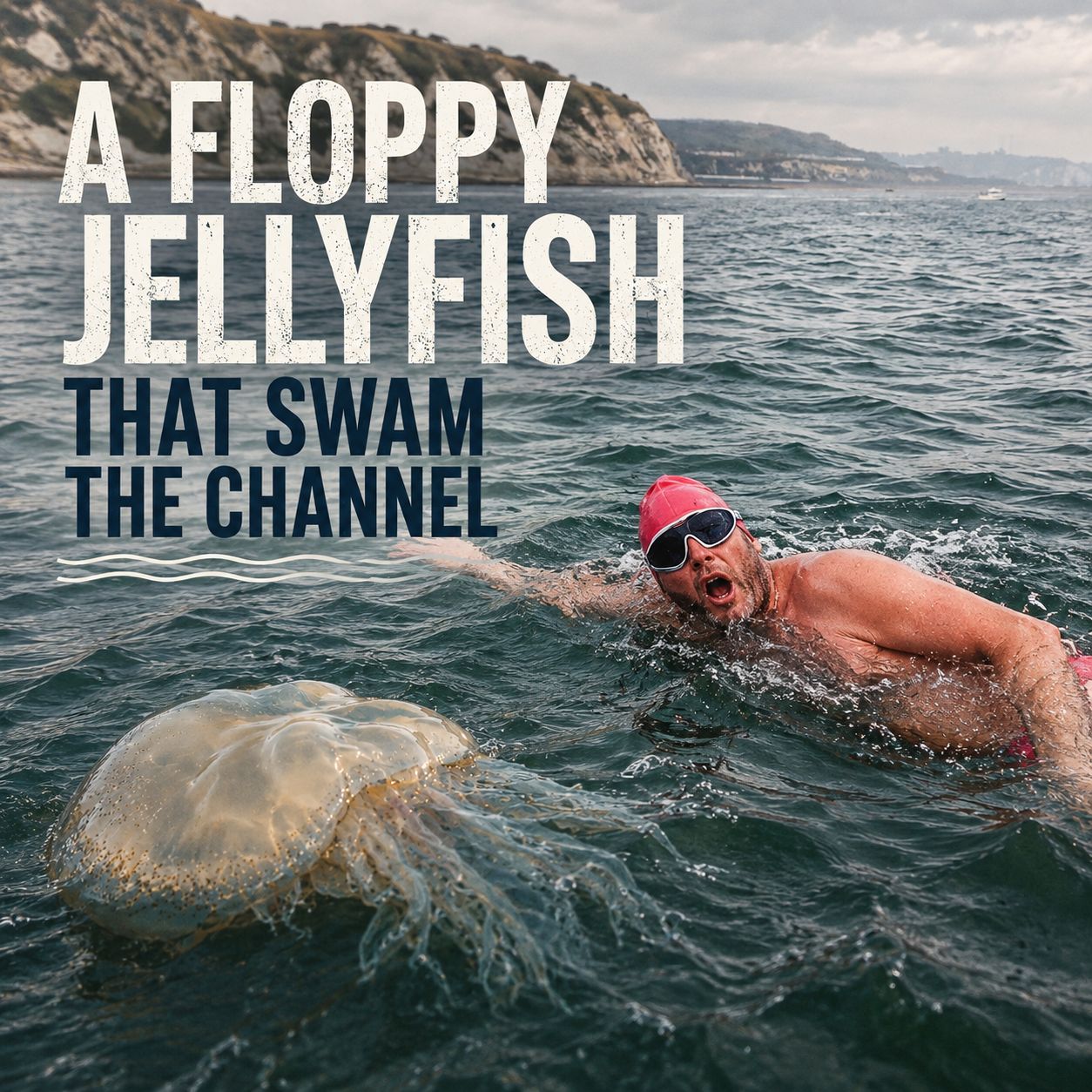
A Floppy Jellyfish That Swam the Channel
“One of my friends describes me as a locomotive: you put me on a track, send me in a direction, and I just plod. It is not graceful, but I get there.”
That might be my favourite description of endurance so far. Not because it sounds heroic. Quite the opposite. It strips endurance back to something wonderfully ordinary: pointing the body in a direction, accepting that it may not look elegant, and continuing anyway.
Jonathon said it while talking about swimming, rowing, running, and all the not-quite-separate things that make up a life in endurance sport. For him, it is “all endurance something.”
That line also does something useful for Trail Voices. This series began with a question: what makes a runner, a runner? Is it distance, identity, community, repetition, suffering, pleasure, or simply the willingness to keep moving? Jonathon complicates the question further, because he is not primarily a trail runner. He is a long-distance swimmer, a former rower, a reluctant runner, and someone who seems to understand endurance less as a sport category than as a way of meeting difficulty.
That makes him a good first Trail Voice.
Not because he confirms what trail runners already think about themselves, but because he lets us look at the same questions from another element.
Water as Trail
In earlier posts, I wrote about sporting embodiment: the idea that we do not simply move through an environment, but experience ourselves, our bodies, and the world through that movement. In trail running, the body is not just transported across terrain. It is in constant dialogue with earth, air, slope, weather, roots, stones, mud, heat, and fatigue. The trail is not scenery. It is a participant.
For Jonathon, water seems to work in much the same way.
He grew up in Australia, where swimming was not really optional. “Swimming is beaten into you from the moment you are in school,” he said. His parents would not let him go to the beach by himself unless he was at lifesaver standard. Water, then, was not only recreation. It was education, safety, belonging, and a kind of practical literacy.
Later, swimming became something else. Not a childhood requirement, but a place to return to.
“Having the sea at the end of the road is like standing under a shower, putting your head back, and having everything wash out of you.”
That sentence feels close to what I have tried to describe in trail running. There are runs where the body moves through the forest and thought loosens its grip. The ground still demands attention, but in a way that simplifies the mind rather than overcrowding it. Jonathon describes the sea similarly. Even when he is not training or racing, simply sitting and bobbing in the water gives him a grounding feeling. “Swimming is my happy place, my safe space,” he said.
But this is not sentimental. He immediately adds the other side of open water: the ocean, jellyfish, and “all that fun stuff” that makes things “not quite as safe.”
That is where the comparison with trail running becomes interesting. Trails often attract us because they are not fully controlled. The surface shifts. Weather changes. The route asks something of us. Water does the same thing. It holds, washes, grounds, and unsettles. It gives buoyancy, but not certainty.
Stroke, Stroke, Counting the Strokes
Much of the research material behind this project draws on Drew Leder’s idea of the body’s “dis-appearance”: the way the body often fades from conscious attention when it is functioning smoothly. We do not usually think about our feet, breath, balance, or stroke until something interrupts them. Pain, panic, injury, cold, heat, and fatigue make the body appear again. In earlier posts, I also wrote about dys-appearance, when the body shows up as discomfort or disruption, and eu-appearance, when it shows up as good, capable, pleasurable, or at home in movement.
Jonathon’s Channel swim gives us both.
His relay crossing of the English Channel meant repeated one-hour swims, getting in and out of the water, waiting, cooling, resetting, and entering again. He described the second hour as more mental than physical. The swimming was hard, but the mind made it harder. At one point, he felt as though someone had a hand around his ankle and was pulling him down.
That is dys-appearance in plain language. The body, the water, and the mind stop being a smooth unit. The swimmer no longer simply swims. The swimmer becomes aware of the possibility of not continuing.
His way through was not dramatic. It was almost mechanical.
“Put one arm in front of the other. Stroke, stroke. Just keep counting the strokes.”
That got him through about twenty minutes. Then the moment passed.
This is where endurance becomes more than fitness. Jonathon did not describe resilience as an inspirational slogan. He described it as a learned bodily routine: something practiced in one context that becomes available in another. If panic comes in real life, he said, you can tell yourself, “Okay, just breathe.”
Endurance training does not only condition muscles, lungs, or joints. It trains attention. It teaches the body and mind how to stay with discomfort without letting discomfort become the whole world.
Alone Together
One of the strongest parts of Jonathon’s interview was his description of community.
Swimming looks solitary from the outside, especially to runners. Trail running has its own contradiction: we gather at starts and finishes, drink beer (maybe something else), exchange stories, join clubs, share routes, and then often spend the actual effort mostly alone. Jonathon described swimming almost exactly the same way.
For the Channel swim, the group mattered because “if one of us failed, we all failed.” On the boat, community was not decoration. It was practical, emotional, and structural. Everyone needed everyone else to keep going.
And yet, once in the water, the swimmer is alone.
Jonathon made the same point about the Dart 10K, UK’s original marathon-distance open-water swim. Everyone is moving down the river together, but no one is chatting much because everyone is trying to breathe. The social world exists before and after the effort. During the effort, each person has to manage themselves.
That feels close to the interdependent self I wrote about in Phase I. Sport does not always fit neatly into individual or collective categories. Trail running and open-water swimming both seem to create a strange hybrid: collective preparation, individual execution, collective meaning afterwards. You do your own work, but the work is held within a community.
Jonathon also noted that since moving to Margate, most of the people he has met have been through the tidal pool, swimming, or something connected to it. It is easier, he said, than walking into a pub and trying to break into a small group in the corner.
That might be one of the simplest arguments for community sport. It gives people a reason to be near each other without having to start with conversation. The activity carries the first awkwardness for you.
The Next Thing
Jonathon does not currently have a race in the diary, but three possibilities are sitting in his mind.
First, Windermere One Way Swim: the eleven-mile swim he once planned to do after the Channel. Second, Rottnest Channel Swim, a 19.7K swim back in Australia that carries the pull of home, memory, and local meaning. Third, the Oceanman series, with events around the world and the added attraction of travel.
What matters is not just the distance. It is the hook.
Jonathon said that the person he used to train with now mostly stays in the pool, so future challenges may not come with the same shared preparation. If he is going to commit, the event needs to offer something more than a number. It needs a treat, a story, or a reason.
That connects to something I keep circling in Trail Voices. Endurance athletes often pretend to be motivated by measurable goals: distance, time, elevation, finish lines, rankings, watches, medals. But when people actually talk, the reason is usually less clean. A place. A friend. A beer. A coastline. A memory. A phrase someone said years ago. The feeling of being washed clean by the sea.
Jonathon’s answer to the final question was wonderfully unpolished:
“I could probably sum up my whole approach as doing it for a beer at the end.”
Then he added:
“The result at the end is always the reward for all the fun you have along the way.”
It would be easy to treat that as a joke. It is partly a joke. But it is also an ethics of endurance. The reward is not separate from the doing. The beer matters because of the shared effort before it. The finish matters because of the body that got there. The story matters because it was not graceful, not easy, and not entirely safe.
So maybe Jonathon’s answer to “what makes a runner, a runner?” is that the category was too small all along. runner, a swimmer, a rower, a cyclist: perhaps these are just different dialects of the same embodied language. Endurance begins where the body has to negotiate with an element and the mind has to decide whether to keep listening. Earth, air, water. Roots, wind, waves. Breath, stroke, step.
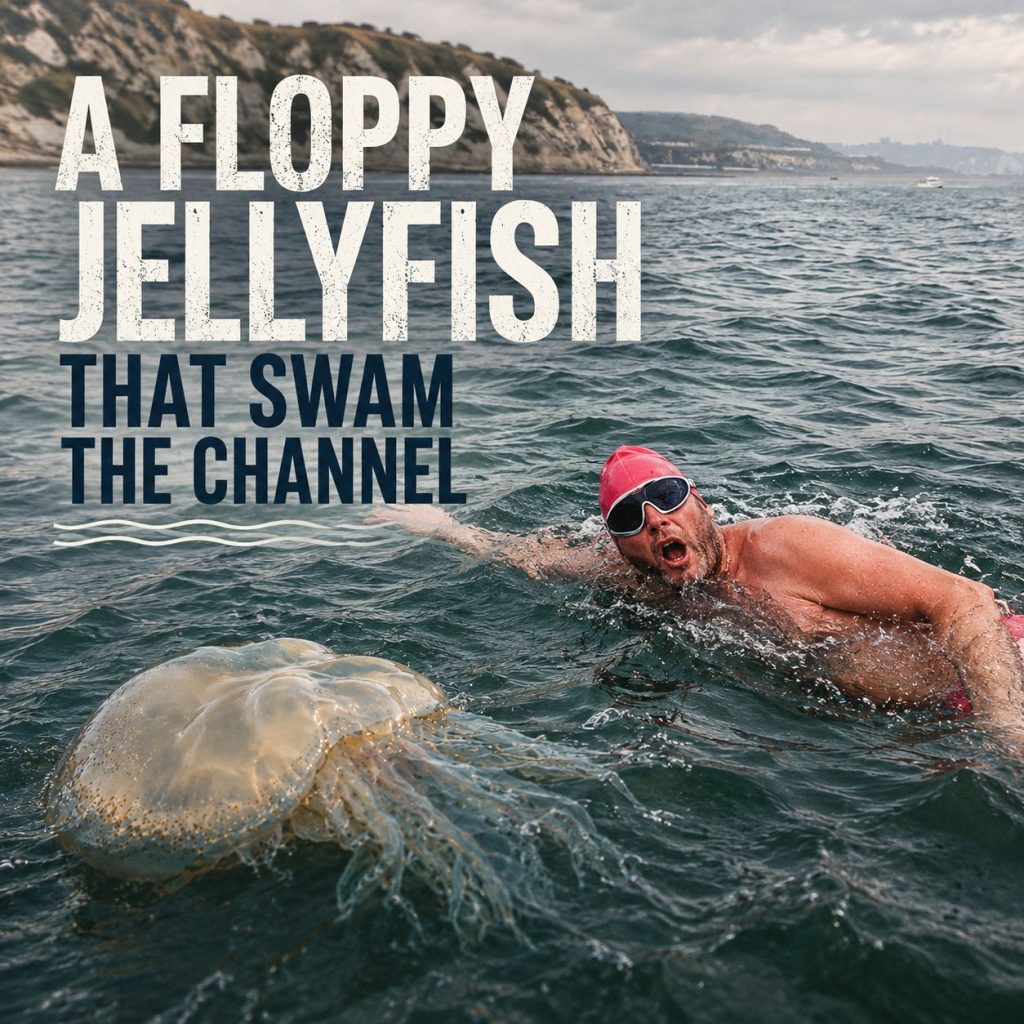
Or, to put it in Jonathon’s terms: “Not graceful. But he gets there.”
And if that still sounds too polished, he offered a better version himself:
“A floppy jellyfish that swam the Channel.”
I am not sure phenomenology has a category for that yet.
But maybe it should.
Written by Ingo@Lozania-Lifestyle.de